
In Brief:
-
Reconciliation, payment plan maintenance, and delinquent account follow-up consume staff capacity
-
Delays and opportunity cost add up in ways that rarely get measured
-
A simple exercise can reveal what a single recurring process costs per semester or year
-
Understanding those costs is the first step toward deciding whether the status quo still makes sense
Blog Post
Software purchases get scrutinized because their costs are visible. There’s a price tag, a business case, and a line in the budget. But manual processes don’t work that way. The hours staff spend reconciling records, updating payment plans, and tracking down discrepancies don’t appear in any proposal, even though they consume real time and real institutional resources, semester after semester.
That mismatch matters. According to CUPA-HR’s 2025 Higher Education Employee Retention Survey, 51% of non-faculty higher education employees report regularly working beyond full-time expectations. At the same time, administrative simplification ranked second among the 2025 EDUCAUSE top higher education issues, reflecting growing attention to the work created by outdated, complicated, and repetitive processes. When staff capacity is already constrained, the resources consumed by an inefficient process become harder to dismiss.
Where does manual work show up in higher ed business offices?
Most bursars and campus business office staff don’t need to look far. Manual processes tend to cluster around the same operational cycles, the ones that repeat every semester regardless of what else is happening on campus.
Take the add-drop period. For a few weeks each term, staff are simultaneously reconciling enrollment changes, adjusting balances, reviewing payment plan updates, and resolving discrepancies between systems. Each task may take only a few minutes. Individually, they don’t seem significant. Together, they add up quickly.
Multiply a five-minute update by hundreds of accounts, factor in the exceptions that need a second look, and add-drop can absorb a significant share of the team’s capacity, just as other priorities are competing for the same attention.
The pattern repeats throughout the year. Financial aid disbursement generates exceptions, account corrections, and adjustment reviews. As payment deadlines approach, teams shift to generating delinquency reports, contacting students, and managing payment arrangements. Month-end and term-end close require reconciling data across the SIS, payment processor, and bank records before reporting can be finalized.
None of this is unusual. These are the normal rhythms of a business office, which is precisely why the effort can be easy to overlook. Because these processes are routine, they rarely receive the scrutiny a software purchase would. Their costs are distributed across tasks, employees, and semesters rather than presented as a single number. Few institutions stop to calculate what they add up to.
The hidden costs of manual processes
Staff time is the most obvious cost of manual work. But it’s only part of the picture.
Every hour spent reconciling records, updating accounts, or reviewing exceptions is an hour the institution is already paying for. The question isn’t whether the work has to get done. It’s whether the current approach is the most efficient way to do it.
Delays are harder to see, but they carry costs of their own. Manual processes introduce lag at every step where information has to be reviewed, re-entered, or verified across systems. Account updates take longer. Payment plan changes take longer. Reconciliation takes longer. That lag has downstream effects: students waiting for account resolution, staff waiting to close a period, reports that can’t be finalized until the data is clean.
Opportunity cost is the hardest to quantify and may be the most consequential. Investing time in manual account updates is energy that can’t go toward helping a student resolve a balance or have a more complex conversation. That tradeoff matters when institutions are already struggling to meet student support needs.
A 2026 EAB survey found that 55% of student-success leaders identified staffing shortages as a barrier to their goals, while 71% said students’ financial challenges negatively affect retention. For a business office, reducing repetitive work can create more capacity for the financial conversations that require individual attention.
Estimating the cost of manual work in your business office
You don’t need a formal audit or months of data collection to produce a useful estimate. Start with one recurring process and track it through a complete cycle.
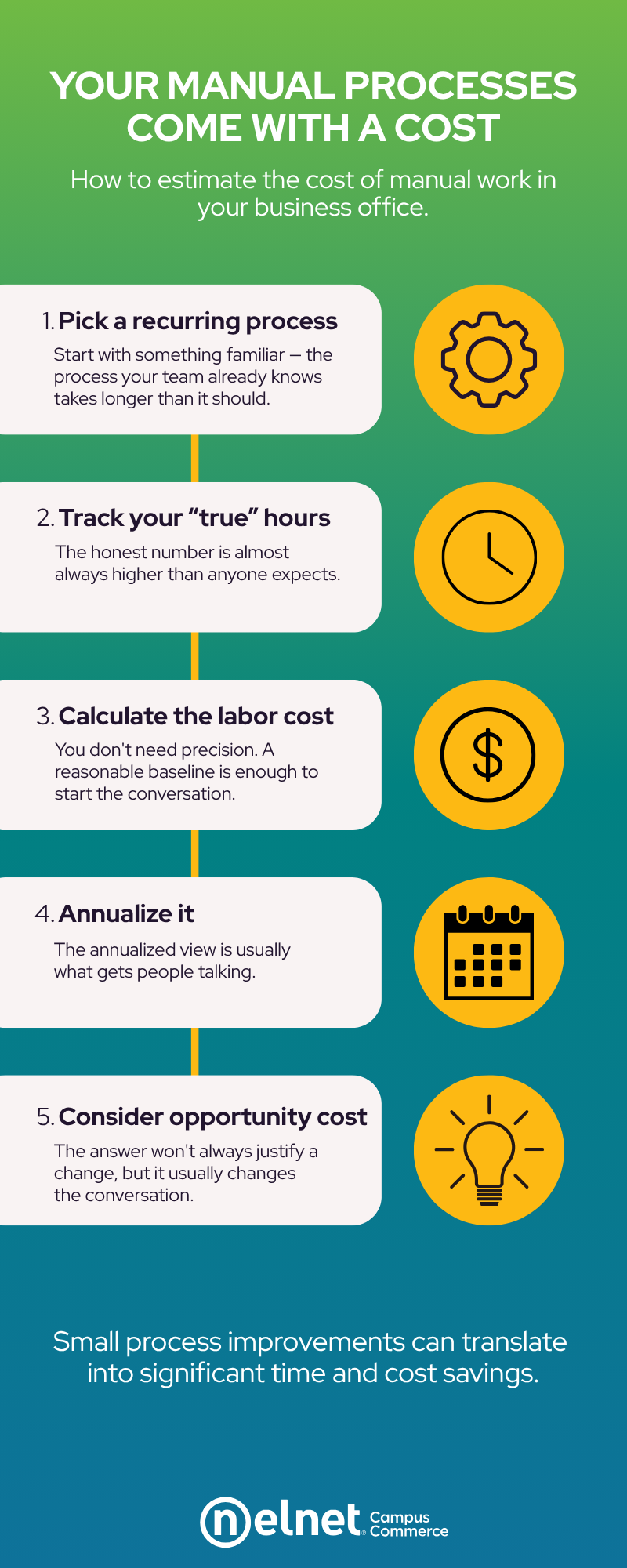
- Choose one recurring process. Something that happens regularly and involves multiple manual steps. Add-drop reconciliation, payment plan maintenance, delinquent balance follow-up, and SIS-to-bank reconciliation are common starting points. The goal isn’t to measure everything at once. It’s to establish a baseline for a single workflow.
- Track actual hours. During the next cycle, record how long staff spend completing the process under normal operating conditions. Focus on actual time rather than estimates, and include everyone involved in the workflow, not just the person performing the primary task.
- Calculate the labor cost. Once you have the hours, estimate the associated cost based on the employees doing the work. It won’t be a precise figure, but it will be a reasonable baseline.
- Annualize it. A process that takes 15 hours once per semester looks very different from one that takes 15 hours every week. Evaluated over an academic year, the picture often changes significantly.
- Consider the opportunity cost. Ask what staff could be doing if those hours were available for other priorities. Would they have more time for student outreach, account resolution, collections follow-up, financial counseling, or something else? The answer won’t always justify a change, but it usually changes the conversation.
To see what this looks like in practice, consider a hypothetical mid-size institution processing 400 enrollment changes during add-drop, with each change requiring two manual touches averaging eight minutes apiece. That equals roughly 107 staff hours per semester. At a hypothetical blended labor rate of $25 per hour, the labor cost would be approximately $2,700 per semester, or $5,400 across two comparable semesters.
That figure captures labor alone. It doesn’t account for delays, error correction, or what staff could have accomplished during those hours.
What the exercise might reveal
Some processes will hold up to scrutiny. They’re infrequent, require minimal effort, and don’t create meaningful delays. Leave them alone.
A process that takes a few hours each week may seem manageable in isolation. Annualized and spread across multiple employees, it can represent a meaningful share of team capacity. The biggest surprises tend to come from the most routine processes. Since they’ve always been done manually, no one has stopped to evaluate them in years.
The scale of the opportunity can be substantial. One anonymous respondent to the 2025 EDUCAUSE Top 10 survey reported removing more than 150 manual or paper forms and replacing them with automation and simplified processes.
Measuring the cost of a manual process changes the question from “Can we afford to change this?” to “What is it costing us not to?”
How institutions are reducing manual workload through automation
Many of the processes that consume staff time in higher ed business offices, including payment plan management, refund processing, student account communications, and reconciliation, are areas where Nelnet Campus Commerce works with institutions to reduce manual steps through automation and integration.
Want to see what this looks like in practice? Read how Bismarck State College and the University of North Dakota reduced manual refund work and redirected staff capacity.
Author: Nelnet Campus Commerce


Get Started
Find solutions that provide payment options, unlimited.

For Students & Families
Are you trying to make a payment?

Student Loans
If you have a student loan in repayment with Nelnet, go to Nelnet.com for assistance.

Payment Plans
If you have a payment plan with an institution, go to MyCollegePaymentPlan.com and search for your school.
